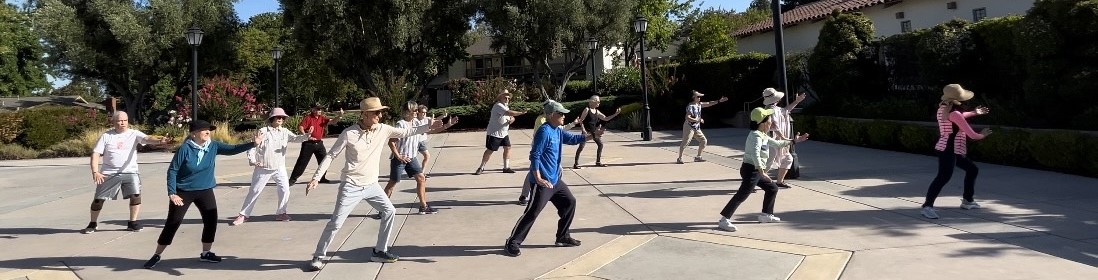
As you start to learn Tai Chi you often hear the advice to, “Breathe naturally.” Although “breathing naturally” should be … well, natural. It might be useful to do a quick check-in to make sure we understand what breathing naturally means in the context of Tai Chi practice, and to see how this breathing fits with the Tai Chi movements.
An essential element of breathing naturally is diaphragmatic breathing (also referred to as abdominal or belly breathing). The diaphragm is a dome-shaped muscle which lies just beneath the lungs. When the diaphragm contracts it pulls oxygen into the lungs and pushs out the belly, hench the term “belly breathing.” Diaphragmatic breathing is an efficient type of breathing which we use at a very early age (e.g. newborn babies use this type of breathing). This type of breathing improves relaxation since it minimizes the use of chest and neck muscles; strengthens the diaphragm; results in decreased blood pressure; increases oxygen uptake by increasing lung efficiency; and increases lung capacity. (Scroll down for exercises) For more information and benefits of diaphragmatic breathing see https://my.clevelandclinic.org/health/articles/9445-diaphragmatic-breathing
After learning and refining the postures for the various Tai Chi exercises, the next progression is to coordinate breathing with movement. For some movements it may be difficult to decide when to exhale and inhale, and how long to hold the exhalation and inhalation. Don’t worry about it. Relax. Breathe evenly and lightly. Be mindful of your breathing. If you are not able to slow your respiratory rate to match the movement do what you are able. Don’t strain or gasp.
Here are some specific suggestions.
Inhale when you: 1) raise your body; 2) bring your arms/legs into the body; or 3) prepare for extension movements (e.g. bringing arms into your body in preparation to punch or ‘hold the ball’ in preparing to extend arms for ‘part wild horses mane’ or ‘brush knee’).
Exhale when you: 1) lower your body; 2) extend your arms/legs; 3) kick or punch.
(reference- Fundamentals of Tai Chi Chuan by Wen-Shan Huang, 2nd Ed. South Sky Book Co, Hong Kong, 1974, p182)
https://my.clevelandclinic.org/health/articles/9445-diaphragmatic-breathing
How do I do diaphragmatic breathing exercises?
When you first learn the diaphragmatic breathing technique, it may be easier for you to follow the instructions lying down.
- Lie on your back on a flat surface or in bed, with your knees bent and your head supported. You can use a pillow under your knees to support your legs.
- Place one hand on your upper chest and the other just below your rib cage. This will allow you to feel your diaphragm move as you breathe.
- Breathe in slowly through your nose so that your stomach moves out, causing your hand to rise. The hand on your chest should remain as still as possible.
- Tighten your stomach muscles, so that your stomach moves in, causing your hand to lower as you exhale through pursed lips (see “Pursed Lip Breathing Technique“). The hand on your upper chest should remain as still as possible.
Diaphragmatic breathing technique (sitting)
As you gain more practice, you can try the diaphragmatic breathing technique while sitting in a chair. To perform this exercise while sitting in a chair:
- Sit comfortably, with your knees bent and your shoulders, head and neck relaxed.
- Place one hand on your upper chest and the other just below your rib cage. This will allow you to feel your diaphragm move as you breathe.
- Breathe in slowly through your nose so that your stomach moves out against your hand. The hand on your chest should remain as still as possible.
- Tighten your stomach muscles, so that your stomach moves back in, as you exhale through pursed lips. The hand on your upper chest must remain as still as possible.